Where to Stay in Mauritius: A Practical Guide to the Island’s Best Areas
Mauritius is a small island, but choosing the right area matters much more than the map suggests. Staying in Grand Baie, Flic-en-Flac, Le Morne or Belle Mare does not simply mean choosing between four similar beach resorts. Each area offers a noticeably different style of trip.
In some places, restaurants, shops and beaches are within easy walking distance. In others, a rental car quickly becomes essential. One coast has more nightlife and everyday infrastructure, while another is better for quiet beaches, large resorts or outdoor activities.
Even the weather varies around the island. The west and north are generally perceived as drier and sunnier, the east is more exposed to the trade winds, and the central plateau is cooler and receives more rainfall. Choosing accommodation based only on a beautiful beach photo can therefore be a mistake.
This guide does not simply list Mauritius's official districts. Instead, it divides the island into the areas that actually matter when choosing a hotel, apartment or long-term rental.
| Area | Best for | Main trade-off |
|---|---|---|
| North: Grand Baie, Pereybere, Mont Choisy, Trou aux Biches | First-time visitors, restaurants, nightlife, boat trips | Busier and more developed |
| West: Flic-en-Flac, Tamarin, Black River | Beach + independent travel + longer stays | A car is useful in many locations |
| South-west: Le Morne, Chamarel | Nature, mountains, kitesurfing, scenery | Limited everyday infrastructure |
| East: Belle Mare, Palmar, Trou d’Eau Douce | Quiet beach holidays, high-end resorts | Windier, especially in the cooler season |
| South-east: Mahébourg, Blue Bay, Pointe d’Esny | Local atmosphere, lagoon, airport access | Fewer restaurants and less nightlife |
| South: Souillac, Gris Gris, Riambel | Wild coastline, quiet stays, road trips | Less suitable for easy swimming |
| Central plateau: Moka, Ebène, Quatre Bornes, Rose Hill, Curepipe | Work, long stays, Metro Express | No beach lifestyle |
| Port Louis | Business, markets, history and city life | Not a beach resort |
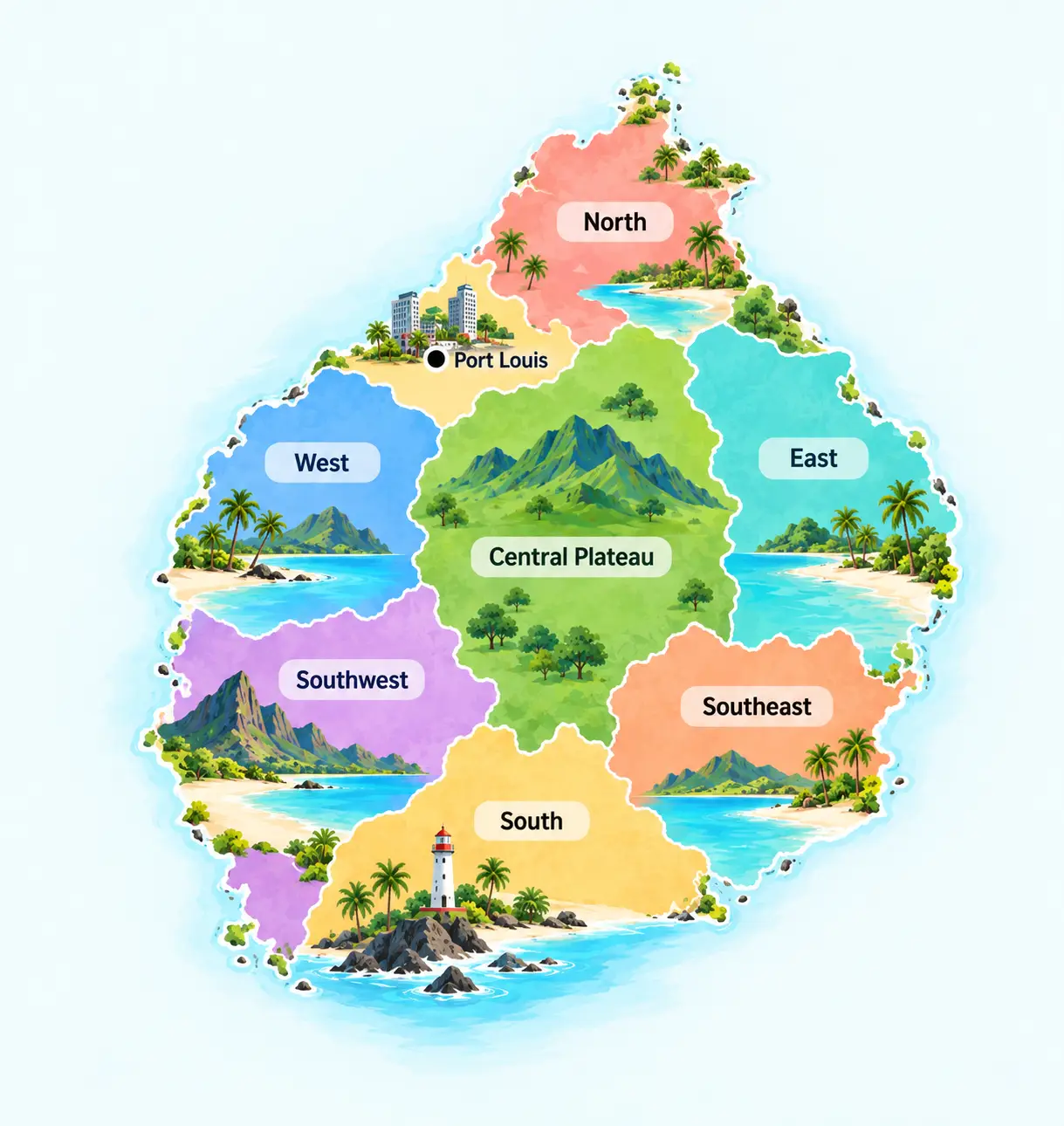
Tourist areas and official districts are not the same thing
The main island of Mauritius is traditionally divided into nine geographical districts: Black River, Flacq, Grand Port, Moka, Pamplemousses, Plaines Wilhems, Port Louis, Rivière du Rempart and Savanne.
These names remain useful for statistics, addresses and geographical orientation, but they are not always helpful when choosing where to stay.
For example, what travellers usually call “the north” covers parts of both Pamplemousses and Rivière du Rempart. Le Morne, Chamarel, Tamarin and Black River all fall within the wider Black River area, but Le Morne offers a very different travel experience from Flic-en-Flac or the more residential parts of Black River. Mahébourg and Blue Bay are both in Grand Port, yet for most visitors it is much more useful to think of them simply as the south-east.
The sections below therefore use practical travel areas rather than formal administrative geography.
The north: Grand Baie, Pereybere, Mont Choisy and Trou aux Biches
The north is one of the easiest choices for a first trip if you want good beaches without giving up restaurants, shops and evening activity.
Grand Baie is the main tourism hub. Restaurants, cafés, bars, supermarkets, shopping centres, car rental companies, diving operators and boat excursions are concentrated in a relatively small area. For travellers who want to leave their apartment in the evening and have plenty of options within walking distance, it is one of the most convenient places on the island.
Grand Baie itself is more attractive for its infrastructure than for having the island's best beach. Many visitors prefer to swim in nearby Pereybere, Mont Choisy or Trou aux Biches. Mont Choisy and Trou aux Biches are especially popular for their longer beaches and relatively calm lagoon conditions.
The north is also a convenient departure point for boat trips to smaller offshore islands such as Îlot Gabriel and Île Plate. Cap Malheureux, with its famous red-roofed church, and several northern fishing villages are also easy to reach.
One of the biggest advantages of the north is that you can manage without relying on a rental car every day. If you stay in central Grand Baie or close to the main part of Pereybere, many daily needs can be handled on foot, by bus or with short taxi rides.
The drawback is the same popularity that makes the area so convenient: the north is more developed and busier. Travellers imagining Mauritius only as empty beaches and isolated villas may find Grand Baie too commercial.
Choose the north if you want:
- a large choice of restaurants and shops;
- nightlife and evening activity;
- boat trips and diving;
- the option to live without a car every day;
- an easy base for a first visit.
The west: Flic-en-Flac, Tamarin, Black River and La Preneuse
The west is one of the most versatile parts of Mauritius. It combines beaches, practical everyday infrastructure and good access to many of the island's main natural attractions.
Flic-en-Flac is the most straightforward tourism base on the west coast. It has a long public beach, restaurants, cafés, supermarkets and a large supply of apartments and hotels at different price levels. It is less busy than Grand Baie but still practical enough for everyday life.
Further south are Tamarin, La Preneuse and Black River. These areas feel less like traditional resort towns and more like residential coastal communities, with villas and services that are particularly useful for people staying several weeks or months.
Tamarin is also known for surf and more open-water conditions, so its coastline feels different from the calm lagoons found further north.
The west is an excellent base for trips to Black River Gorges, Chamarel, Le Morne, Île aux Bénitiers and other destinations in the south-west. It is also the obvious side of the island for sunset views over the ocean.
During the cooler season, the west is often a comfortable choice because it generally receives less rain than the central plateau and eastern coast. Outside central Flic-en-Flac, however, having a car makes daily life considerably easier.
The west works well if you want:
- a combination of beach time and island exploration;
- a base for more than one or two weeks;
- easy access to mountains and the south-west;
- sunset beaches;
- a quieter alternative to Grand Baie.
The south-west: Le Morne and Chamarel
Le Morne is one of the most visually impressive parts of Mauritius, but it should be chosen for scenery, nature and outdoor activities rather than urban convenience.
Le Morne Brabant, a UNESCO World Heritage Site, rises directly above a large lagoon. The area has some of the island's best-known hotels, beautiful beaches and one of Mauritius's main kitesurfing zones. The famous “underwater waterfall” optical effect can also be seen from the air just offshore.
Further inland are Chamarel, the Seven Coloured Earth, Chamarel Waterfall, Ebony Forest and convenient access to Black River Gorges National Park. For travellers interested in nature, the south-west offers far more than the most built-up parts of the north.
The trade-off is infrastructure. Le Morne is not a good base for someone who wants to walk to a different café, supermarket or bar every evening. Services are spread out, and a rental car or frequent taxi rides become part of daily life.
The south-west can also be windy during the cooler season, which is exactly why kitesurfers value it so highly.
Le Morne and the surrounding area are especially good for:
- kitesurfing and water sports;
- hiking and mountain scenery;
- dramatic landscapes;
- quiet stays in good hotels or villas;
- trips around Chamarel and Black River Gorges.
The east: Belle Mare, Palmar, Trou d’Eau Douce and Poste Lafayette
The east coast comes closest to the classic resort image of Mauritius: long pale beaches, broad lagoons and large hotels with spacious grounds.
Belle Mare is the main beach destination on this side of the island. It has long stretches of sand and many well-known resorts. The area is ideal for travellers who want to spend most of their time near the sea and do not need a busy town nearby.
Trou d’Eau Douce has more of a village atmosphere and is best known as the main departure point for boat trips to Île aux Cerfs. It offers a more independent experience than staying inside an isolated resort, although the choice of shops and restaurants is still smaller than in Grand Baie or Flic-en-Flac.
Poste Lafayette and the north-east are even quieter and less developed. This appeals to travellers looking for privacy, but it also makes a car much more useful.
Weather is the main factor to consider on the east coast. It is more exposed to the south-easterly trade winds. July and August can feel noticeably windier, and the east, south and central plateau generally receive more winter rainfall than the western side.
That does not make the east a poor choice — it simply means it should be chosen with the season in mind.
Choose the east if you want:
- long, attractive beaches;
- a quiet holiday;
- a high-quality resort with a large property;
- easy access to Île aux Cerfs;
- less urban activity.
The south-east: Mahébourg, Blue Bay and Pointe d’Esny
The south-east makes it easier to experience everyday Mauritius rather than a purpose-built resort environment.
Mahébourg is a historic coastal town with a market, local cafés and a much less tourist-oriented atmosphere than Grand Baie. It is a good choice for travellers interested in local life as much as beach infrastructure.
Nearby Pointe d’Esny and Blue Bay provide access to some of the area's best lagoon scenery. Blue Bay is particularly well known for its clear water and marine park, making it attractive for snorkelling and relaxed swimming. Pointe d’Esny feels quieter and more residential.
Another advantage is proximity to Sir Seewoosagur Ramgoolam International Airport. That is useful on arrival and departure days, although airport proximity alone is rarely a reason to choose the area for an entire holiday.
For long stays, the south-east has fewer international restaurants, shops and entertainment options than the north or west. In return, it offers a quieter and more local atmosphere.
The south: Souillac, Gris Gris and Riambel
The southern coast shows a very different side of Mauritius. There are fewer protected lagoons and more open ocean, cliffs, wind and lightly developed coastline.
Gris Gris near Souillac is one of the best examples. Visitors come for the powerful waves and dramatic coast, not for calm swimming. With less reef protection, the ocean here feels much more exposed.
Souillac can work as a small base for exploring the south, while Riambel and nearby areas offer quiet accommodation away from the main tourism centres.
The south is excellent for road trips, coastal walks and travellers who prefer a less polished side of the island. For a first family holiday centred on easy daily swimming, however, the north, west or east is usually more practical.
The central plateau: Moka, Ebène, Rose Hill, Quatre Bornes, Vacoas and Curepipe
Most tourists do not consider central Mauritius, which makes sense for a conventional beach holiday. There is no coastline, the climate is cooler and wetter, and the landscape is more urban and residential.
For people coming to work or live for several months, however, the centre can be a practical choice.
Ebène is one of the country's main business districts. Moka combines newer development, offices, shopping and a central location. Rose Hill, Quatre Bornes, Vacoas and Curepipe are large residential towns with markets, shops, schools, clinics and ordinary urban life.
The Metro Express runs through this central urban corridor, linking Port Louis and Curepipe via several key towns. It is useful for regular travel within the centre, but it does not extend to Grand Baie, Flic-en-Flac, Belle Mare, Le Morne, Blue Bay or the main beach destinations.
The central plateau is therefore worth considering when work, school or another daily commitment is located there — not because it offers a resort experience.
Port Louis: the capital is not a beach base
Port Louis deserves its own section because older travel guides often fold it into “central Mauritius”. In practical terms, it is a completely different type of place.
The capital contains Central Market, Caudan Waterfront, Aapravasi Ghat, government offices and much of the country's business infrastructure. It is busy during the day, and road traffic can become heavy during peak hours.
For most leisure travellers, Port Louis is better treated as a day trip than as a base for a beach holiday. For business travellers, the opposite can be true: if you need to be in the capital every day, staying nearby or along the Metro Express corridor can be far more practical than commuting from the coast.
What about Rodrigues and Agalega?
Rodrigues and Agalega are not “areas of Mauritius island”, so they should not be grouped together with the north, west or central plateau.
Rodrigues is a separate island and an autonomous outer island of the Republic of Mauritius, roughly 560 kilometres east of the main island. It has its own rhythm, beaches, lagoon and tourism infrastructure. Visiting Rodrigues makes more sense as a separate trip or as an extension to a stay on Mauritius.
Agalega lies much farther away and is not a conventional tourism extension of a holiday on the main island. Limited transport and visitor infrastructure make it a very different proposition. For a first trip to Mauritius, Agalega has no practical relevance when choosing where to stay.
Where to stay without renting a car
If you do not plan to drive, the exact location of your accommodation matters even more than the broader area.
Grand Baie is usually the easiest option because restaurants, shops, tourist services and transport are concentrated relatively close together. Central Flic-en-Flac and Mahébourg can also work well if your apartment is close to the places you will use every day.
Public buses connect many towns and beaches, but they are much less convenient for nature attractions and trips between opposite coasts. The Metro Express only helps within the central urban corridor and should not be thought of as a transport network for the tourism coasts.
Before booking an apartment, check the walking distance not only to the beach but also to a supermarket, café, pharmacy and bus stop. Two properties in the same town can offer completely different levels of convenience without a car.
Which areas are best for a long stay?
For a stay of several months, priorities change slightly. The beach still matters, but after a few weeks supermarkets, healthcare, internet quality, gyms, cafés, parking and daily travel times often become equally important.
For many remote workers, the most practical choices are:
- Grand Baie and the north, if social life, restaurants and services matter most;
- Flic-en-Flac, if you want to live beside a long beach without giving up useful infrastructure;
- Tamarin and Black River, if you prefer a quieter residential environment, nature and have a car;
- Moka or Ebène, if work and access to the business centre matter more than living beside the sea.
Belle Mare, Le Morne and more remote parts of the east can be excellent for a holiday, but anyone planning a long stay should check supermarkets, healthcare, internet and transport around the exact property rather than judging the whole area by resort reviews.
Where should you stay on a first trip?
If this is your first visit to Mauritius and you want to minimise the risk of choosing the wrong area, the decision can be simplified.
Grand Baie and the north are the most versatile choice for travellers who want restaurants, excursions, infrastructure and good beaches nearby.
Flic-en-Flac and the west offer a strong balance for independent travel, especially if you plan to rent a car and explore the island.
Belle Mare and the east make sense for a quieter resort holiday focused on a good beach rather than urban convenience.
Le Morne should be chosen for scenery, kitesurfing and atmosphere, not for easy everyday errands.
Mahébourg and Blue Bay suit travellers who prefer a more local environment, quieter surroundings and the south-east lagoon.
The south is generally better for day trips or for travellers who deliberately want isolation and a wilder coastline.
There is no single “best area” in Mauritius. The right choice depends on how you want to travel. Someone without a car who wants to walk to restaurants every evening may find Grand Baie much more practical than scenic Le Morne. A family looking for a quiet beach and a high-quality hotel may prefer Belle Mare to the busy north. Someone staying for several months may find Flic-en-Flac or Black River offers a better balance between the sea and everyday infrastructure.
Mauritius is small enough to explore several parts of the island during one trip, but not so small that location becomes irrelevant. Choosing the right base can save hours of driving and significantly change the experience of the island.
Information checked: 18 September 2026.
Sources for information that can change: Statistics Mauritius, Mauritius Meteorological Services, Ministry of Tourism Mauritius, Metro Express Mauritius, Government of Mauritius and current MauriceTop material on transport and long-term living. Weather, transport and local services can change, so anyone booking a long-term rental should also check the exact property location before committing.
Author: MauriceTop Editorial Team
Comments
Read also
All articles
Why a Business in Mauritius Should List Itself in Places & Venues
Why a restaurant, hotel, coworking space or other Mauritius business can benefit from a permanent local-directory listing alongside Google Maps, Instagram and its own website.
Whales in Mauritius: same-sex love, battles with squids and 20 minutes of sleep
A huge carcass emerged from the water a few meters away from us. As if in slow motion, the sperm whale flew up above the…
How to Attract Customers Through Bloggers in Mauritius: Using “Promo” Listings
How businesses and bloggers in Mauritius can find the right partners, agree on cooperation and measure results through “Promo” listings.
The Top 10 Little Known But Impressive Facts About Mauritius
Mauritius is a small island nation located in the Indian Ocean, and while it may not be as well-known as some other tourist destinations, it…
Long-term rental in Mauritius
How to safely rent a home in Mauritius for several months: searching, checking the owner and agent, contract, deposit, handover and scam prevention.
How to Promote an Event in Mauritius: Events, Social Media and Partners
A practical guide to promoting events in Mauritius: create a clear listing, use Events, reach people through social media and partners, and keep information current.